Wednesday, October 21, 2009

Henri Lefebvre, diagram of nested scales

G = Global g=global
M= Transitional m=transitional
P = Private p=private


Friday, October 9, 2009

diagram video

I thought it would be good to post the video I made for our meeting yesterday.


For saturday let's all have something prepared for what we want on our boards. We all have an idea of what this thing is, so it's time for us to start thinking about how our ideas will be communicated to the jury. I think we should also make some sort of timeline for it to get done. We have 24 days.

Thursday, September 24, 2009

Bring the Noise! barrier

Noise Barrier

by the same guy as Pamphlet #26: 13 projects for the sheridan expressway.
nice simple graphics, and clear communication, indicating cross-functionalities and nascent capacities.

Tuesday, September 22, 2009

BIG TED talk

Bjarke Ingels did a TED talk recently. Two things came out of it with regards to the competition and our meeting tonight:

1. his talk about evolution - starting at 2:15 and climaxing at 2:50 where he shows video of how many models they stuck into the site model in initial design phases. It reminded me of our goals at this point and our meeting tomorrow (to reiterate Nico's sentiment at dinner tonight); no ideas are stupid right now. Throw them all out there.

2. Starting @ 11:32 - Showcasing the Mountain Dwelling project, Ingels explains and diagrams how the firm uses two separate forms, with totally different functions, and combines them in order to make both better spaces (or make one space way better using the other space). I think this competition is all about that theme and it is something we touched upon during dinner tonight.


Sunday, September 20, 2009

Site Visit 1

Well, despite the hardships suffered on today's site visit we did manage to get some things done. Nico, we all hope you are feeling better by the time you read this. Will, Jon and I stopped by Tigard and spent some time under the viaduct on our way back from Portland, followed up by a long conversation on I-5 about the competition and our first thoughts as a group. This post should serve to fill you in as well as help Will and Jon match my words to some graphics.

I am posting the boards that were completed prior to the meeting so everyone can get a look at them. We talked about the basic ideas of the boards without ever looking at them, and came up with some great conclusions. I think it would be best if we all start a dialogue about the major themes revealed in this assignment. 

Will and Jon - take one theme and expand on it in the comments section of this post. Basically we are trying to catch Nico up on what he missed by adding our own words to these boards. 
Nico - The text is important to understanding the ideas, especially without our contributing voices. Please follow up with some questions, or thoughts you have on the boards as well. 


click on the images to see full size documents in my picasa album

Obviously these boards were meant to be seen side by side:


Monday, September 14, 2009

Further analysis of finalists

I think it is important to have a more formal analysis of the projects. I will absorb the information on these boards much better if I try to summarize and analyze it myself. Will posted his opinions, Nico did the same with his (reduced to an effective, two or three word description), but I think to gather some common themes, strengths and weaknesses, etc. will give us some guidelines as to what the judges are looking for in a good proposal. So after spending some time with all the boards, this is my analysis:

format: 
Title (abbreviated) - "New title based on primary goal"  - A. Primary Impact: Key phrases describing the primary impact or goal. This is the sales pitch in one sentence. B. Ancillary: supporting impacts or benefits  C. Impacted Area: Determined geographically  D. Strengths: of proposal and physical submission. This can be about the graphics, the layout, the concept, etc. This section basically tries to get a feel for what the judges like about the project  E. Weaknesses: dealing with the same themes as the strengths only searching for what might hold these proposals back, or what keys us into understanding what is not so important in our own work. 

1. Border Wall as Infrastructure - "Ecological, Social bang for the buck" - A. Primary impact: Improving upon a proposed border wall to get more beneficial results and efficiency for the dollar. Economic sensibility. B. Ancillary: energy generation, local ecology, water distribution, habitat restoration (30 different proposals, not all are listed on the website)  C. Impacted Area: border of US and Mexico (as well as any population in close proximity)  D.  Strengths: probably the most simply presented submission of the finalists. A wide range of possibilities narrowed to a specific geographic location. Renderings are clean and simple. E. Weaknesses: No major cities are effected by this proposal. Four other finalists focus on at least one major U.S. city. There isn't much room for this proposal to grow in the second round. Besides planning which of the 30 projects will go where along the border, I don't know how much more depth this project will show. Of all of the finalists, this project seems to have the least overall impact. 

2. Water Refugees - "Follow the Freshwater" - A. Primary Impact: Utilizing the rust belt's loss of population and its freshwater resources to relocate world populations threatened by future water scarcity. The primary goal of this project is to save people from drought. The emphasis is humanitarian. B. Ancillary: Repopulating major cities in the U.S. (a romantic benefit) as well as some detail given to the ecological fabric provided in the restructuring of these cities. C. Impacted Area: Detroit, Milwaukee, Buffalo, Chicago, Cleveland and potentially any area threatened by water scarcity. D. Strengths: Again, simplicity in diagrams and aerial renderings. There is a lot of room for this project to develop in the "redensification of under-utilized post-industrial landscapes" E. Weaknesses: I don't see much practicality in relocating populations from around the world to the rust belt of the U.S. Yes, there is room to fit the billion people, but it might be underestimating the desire/ability of these populations to relocate. 


This image came from a blog about the competition but was left off the WPA site. 

3. Coupling Infrastructures - "Water Economies" A. Primary Goal: Converting the sea back to its recreational use B. Ancillary: Allowing multiple economic opportunities for the production of salt, water, and more efficient greenhouses. C. Impacted area: Southeast (as a model for possible global impact) D. Strengths: Probably the best boards for their balance of great diagrams and renderings, depth, detail. E. Weaknesses: As Will pointed out, the idea of infrastructure as an extension of nature is hard to buy. Floating economic pods don't seem all that natural either. 

4. Hydro-Genic City 2020 - "The Power of Water"  A. Primary Goal: Community building by using the mechanistic waterworks of LA B. Ancillary: Light rail stops, water cleaning, accessible spaces in the city.  C. Impacted area: Limited to Los Angeles D. Strengths: Renderings are beautiful, detail, specificity (the section of the proposed water tanks is especially impressive). E. Weaknesses: This only effects LA, and is not all that ecological. The emphasis is on creating gathering spaces, not the ecological fabric. 

nice section of the tank (this team has some sexy boards)


5. Local Code: Interstitial Landscape - "Leftovers" A. Primary Goal: Converting leftover streets for communities. The epitome of the Pruned: Under Spaces series. B. Ancillary: no emphasis on any ancillary goals (besides maybe the ecological benefit of increased park-like spaces using native plants) C. Impacted Area: San Francisco, New Orleans, Seattle, New York City D. Strengths: Concrete, unambiguous, mathematical, very clear diagrams, beautiful as a whole, poetic prose E. Weaknesses: Obviously I like this project a lot, but I am uncertain about the long term impact. These spaces are left over for a reason. Local code has deemed them "unaccepted" based on some kind of organic population growth. I think the process and the motivation is solid, and you could very well make these spaces inviting, i'm just not sure such small spaces can change the dynamic of the surrounding neighborhood enough to make the impact last. Further analysis and development will be really interesting.  

6. Urban Algae: Speculation and Optimization - "Nascent Capacities (Nico's title)" A. Primary Goal: Dealing with carbon dioxide emissions B. Ancillary: Community spaces, direct access from Brooklyn to the Battery, ecological fabric. C. Impacted area: Specific to NYC but they speak of wide-scale applications. I'm not sure how this project deals with toll booths and power plants, but it says it does. If that is the case this could be implemented across the country. D. Strengths: Specific proposal, draws on previously planned bridge (historical connection), the first board with the sections and the plan is very strong, one of the best boards of the finalists. Weaknesses: I'm not a fan of the renderings. However I am interested to see where this one goes in the next round (dealing with the toll booths and power plants). 


one of my favorite boards (not the sexiest but great info)

That's it for now. I suggest people comment on this post to discuss common themes and things we feel are important for our own work (or disagreements to my opinions). I don't think we should spend much more time analyzing the finalists because we have enough of our own shit to do, but this was a good exercise for me. 

Countdown: 7 weeks (49 days) until our boards are due!

If anyone is going to be around tonight, my brother is in town for a few days. I'll be headed to bingo tonight and Girltalk on Wednesday. All are encouraged to come!


Saturday, September 12, 2009

Junkspace

"Junkspace is a Bermuda triangle of concepts, a petri dish abandoned: it cancels distinctions, undermines resolve, confuses intention with realization. It replaces hierarchy with accumulation, composition with addition"

"More and more, more is more."


Junkspace: what remains after modernization has run its course, more precisely, what coagulates while modernization is in progress, its fallout.

In addition to this term conjuring up images of peripheral spaces like freeway embankments, shopping mall parking lots, Junkspace makes me think of the very architecture we are dealing with, one that makes up an economically driven consumer shopping park. One that prefers efficiency above all else. We are dealing with strip malls, parking lots, highways bypassing main street, the typical answer to 'more for cheaper.' With the vehicle driving us (no irony intended) to create an inhumanely scaled infrastructure, residual space is inevitable. Junkspace creates junk space.

It seems that our political enactors of our current infrastructure are subordinate to the Dillards and the JC Pennys. Or maybe they shout in unison "GROW GROW GROW, MORE MORE MORE," in which a resounding response is "PLACE PLACE PLACE."

But these macro economies also leave residual space for the micro economies. Acting informally, they make use of junkspace.


Could we build in an open source infrastructure to support this economic activity? The beauty of open source is its loose frame work which is adaptable and malleable. The experience is user generated.

Its obvious that our built environment has created this residual left over space. I thought Nico sharing Prune's post on "under spaces" was appropriate, which there is a follow up that is equally interesting. The professional competitions addressed this issue in part with the '1B Global Water Refugees', 'Hydrogenic City', and most directly, 'Local Code.' The impending water crisis seems to be a popular subject as well... only one addressed renewable energy, and it is my least favorite of them all, Solar PV panels. In my opinion the most interesting ones where the 'Urban Algae', 'Water Refugees', and 'Local Code'. 'Urban Algae' was a unique way to think about byproducts as a catalyst for public space. Its fun to have a visual on the surface of the water for the tunnel. It's a infrastructural diagram for how our trash be used as fuel for something desirable. 'Coupling Infrastructures' did a similar thing but was less believable, or maybe I disagree with the premise of the salton sea in general (pre-disposition). They claimed that "infrastructure [becomes] an extension of nature" when the whole place is contrived and unnatural to begin with. Though they had some great boards. This one is especially beautiful. 'Hydrogenic City' tried to pull way to much into one project, and I thought it was probably total speculation that all those activities were compatible.

In another area... I was looking at MIT: Technology Review and noticed some really great maps, and luckily the article was online. This is not quite the scale we are looking at but it thought it was interesting that different regions are strong in there specific areas of renewable energy. Could we pull anything significant about our site from these?


The article on intelligent electricity might be useful as well.

Blah... that exhausts my thoughts on the project lately... now I'm ready to dive into Nico's assignment. :D Anybody have additional thoughts on the schedule... the due dates are coming up.

Wednesday, September 2, 2009

Analysis of Professional Finalists

(see analysis in comments section)

Update: All the boards are posted now on WPA website! I've linked the titles to the Boards on the CityLab site, and the firms names to their website. Great stuff, and none of it is out of our reach if we stay focused, bold, and fearless.


P1014 Urban Algae: Speculation and Optimization
Mining Existing Infrastructure for Lost Efficiencies

Proposal location: applicable nationwide to tollbooths, coal-fired power plants, automobile tunnels and other locations of CO2 production; main sample project is a Brooklyn to Manhattan pier/bridge armature

Primary issues: This proposal seeks to turn negative byproducts of auto use and coal-fired energy (CO2) into ecological, economic, and social opportunities. Three site types are targeted - toll booths, coal-fired power plants, and automobile tunnels. The team's design for a pivoting, pier-like, armature between Red Hook, Brooklyn and the Battery in Lower Manhattan not only captures the CO2 from the underwater auto tunnel, encouraging photosynthesis and alternative fuel production using algae pontoons, but also creates new public spaces (swimming pools, boardwalks, and plazas) and new locations for ecological or agricultural development including controlled wetlands and fish habitats.

TEAM: PORT


P1117 Coupling Infrastructures: Water Economies/Ecologies

Proposal location: case studies include Salton Sea, Mono Lake, and Owens Lake in California and Pyramid Lake in Nevada yet proposal is applicable to numerous locations, particularly in the southwest.

Primary issues: This proposal focuses on America's impending water crisis, particularly in cities in the southwest where growth is high and water availability is limited, by rethinking water use, distribution, and storage. Using the Salton Sea as a model site, the proposal envisions "converting the Sea back to its recreational use while allowing multiple economic opportunities for the production of water, salt, and more efficient greenhouses." Here "infrastructure [becomes] an extension of nature." Island pods provide for salt harvesting, recreation, and new animal habitats.

TEAM: Lateral Office/Infranet Lab


P1145 Border Wall as Infrastructure

Proposal location: US/Mexico border

Primary issues: "[T]here exists far more potential in a construction project that is estimated to cost up to $1,325.75 per linear foot." Recognizing the high cost, limited effectiveness and unintended natural consequences of the new, multi-layered US/Mexico border wall (disruption of animal habitats, diversion of water runoff that has caused new flooding in nearby towns), this proposal names 30 alternatives (covering nearly the whole of the Mexican alphabet, literally from Aqueduct wall to Zen wall) that might better combat the energy crisis, risk of death from dehydration, disruption of animal habitat, loss of vegetation, negative labor relations, missing creative vision and lack of cross-cultural appreciation likely in the government sponsored version.

TEAM: Rael San Fratello Architects


P1155 1,000,000,000 Global Water Refugees

Proposal location: Great Lakes Region

Primary issues: Combining the rust belts' loss of population with its abundance of fresh water, this proposal outlines a strategy for redensification of under-utilized post-industrial landscapes (parts of Milwaukee, Buffalo, Detroit, Chicago, and Cleveland) by relocating populations threatened by water scarcity.

TEAM: UrbanLab


P1168 HYDRO-GENIC CITY, 2020

Proposal location: Los Angeles, with other possible urban applications

Primary Issues: Through the development of integrated, ecologically sensitive, and aesthetically compelling architecture, this proposal seeks to turn the often mechanistic infrastructural system of LA - in this case, the waterworks - into an interactive and sensory series of public nodes. As mist platforms/light rail stations, urban beaches, energy producing water treatment plants, solar-panel encased water towers, pools, and aquatic parking lots, these water-based landscapes become organizational moments for community building.

TEAM: Darina Zlateva and Takuma Ono


P2001 Local Code: Healing the Interstitial Landscape

Proposal location: San Francisco, with secondary applications, per the proposal, in New Orleans, Seattle, and New York City

Primary issues: Tapping into the Department of Public Works catalogue of San Francisco's "unaccepted streets" (those no longer maintained by the city and hence neglected and often impassable), this proposal utilizes various computer models and statistical data to determine and propose new public, park-based uses for these interstitial spaces. Over 1600 of these sites are available, a selection of which are analyzed for the proposal in terms of elevation and topography, microclimate, soil type, hydrology, population density and demographics, economics, crime, and existing networks to determine the most parametrically appropriate transformation of use.

TEAM: Nicholas de Monchaux & Associates

Process

We now have out of the way the sentiment that we should 'think' about how we are going to 'think' about this project.

a) We want to approach it from all scales

b) This should come out of direct contact with the site.

c) Our method / process should be... yet to be decided. Let me start a dialogue about this. It seems that the approach to this project is like this... "our society / country has some dysfunction because of (among many reasons) our built infrastructure, at a moment when we need to take on massive infrastructure building projects we should think about how we invest in it and what its social implications are." The assumption seems to be that infrastructure has a small part in determining peoples behavior/lifestyles, which I believe holds some truth. This is what I inferred from the text... the have it stated in the positive "We encourage projects that explore the value of infrastructure not only as an engineering endeavor, but as a robust design opportunity to strengthen communities and revitalize cities."

With this idea is the approach that our city infrastructure acts as a healing process between the relationship of man and environment.

There are many angles we could look at this, as stated in the brief "This notion of infrastructural systems is intentionally broad, including but not limited to parks, schools, open space, vehicle storage, sewers, roads, transportation, storm water, waste, food systems, recreation, local economies, 'green' infrastructure, fire prevention, markets, landfills, energy-generating facilities, cemeteries, and smart utilities."

*This is a quick thought I had at the end of the email* I think we should look at current scales in which people approach our infustructure, and create an arguement for an approach at a different scale... smaller, more human, more connections... a more human scale of the relationships of these infustructure networks. This would be conducive to work in a way that Stan Allen would be proud of *End of flash thought*

I really haven't done a ton of reading, i've been briefed on Stan Allens work, which seems like it has more emphasis on the physical / quantitative which precedes before value / qualitative judgments. Either way... it inherently needs reference to an actual place.

Meaning, lets figure out our method... and lets start getting into specifics... lets generate some shit, I've got a baby on the way, its not going to wait... let go!

Integral Theory - what is our problem?

This comes from my brother's blog. He is writing about an Op-ed piece by Thomas Friedman about nature conservancy. I have starred and highlighted the two sections that I feel most appropriate to our dialogue (paragraph 6 and the last line of the post). 

Notice the word "integrated" above. As I struggle to explain Integral Theory to everyone, one thing I keep coming out with is that it's mostly a different way of looking at things, a different set of lenses through which to look at the world, one which tries to take into account that reality is unified. 

What this means is that if there's a problem, it's most likely either one of viewpoint, or one of orientation. 

How can a change of viewpoint change everything?

Well, remember when fire was magic, some random event or act of the gods? Of course not. Every advance that we make occurs because of a shift in viewpoint, a greater, deeper, or wider understanding, or a more encompassing, more connected worldview. 

There are no problems in the Universe. You have problems. There are two ways to eliminate them: externally and internally. If you no longer care about something (internal) it's not a problem. If you remove the external cause of the problem, it's not a problem. Both are important. You won't be a very good human if you ignore the external reality of problems. You'll probably starve to death. But you also won't be a very good human if you don't grow past some of your problems. You'll be waiting for your mother to feed you, and you'll starve to death. Both are shifts in viewpoint: you either change your view of what you are and what your relationship to the world is, or you change the way you look at the outside world, which changes what you can do to it and in it. 

***The shift in perspective that Friedman is discussing is from one where each act in the universe, or process (a series of acts and reactions through time) is basically unrelated to each other (SDi 5) to one which recognizes that every act has consequences for every other ongoing process, or that every process and system is linked to each other (SDi 6). You could also view this in terms of input and output, in the movement from an understanding of inputs and outputs occurring separately to one where every output is a different process' input, creating cycles.***

Much of where modernity has gone awry is in disrupting cycles between the output of one and the input of another, creating waste, which doesn't exist in the natural world. 

This is not to say that man has no right to tinker with what's there: as mentioned in the end of the article, we can make nature better, or rather, better for us, which is the process of solving problems externally. (Very simply, making a roof underneath which to hide from the rain.) ***What we need to understand is that instead of creating a different framework to solve every problem we have, we already have been given the perfect framework within which to work, we just need to recognize it as such.***

I take from this a strong link to the 'Sustainability and Wildness' post. Both of these writings beg for us to IDENTIFY A PROBLEM, then ERASE EVERYTHING we 'know' about that problem in order to solve it. As 'Wildness' points out we are a culture obsessed with 'sustainability' but very few people have asked themselves what the hell sustainability really means or why they actually want it.

In thinking about this competition over the summer - and in the broader sense thinking about this since discovering architecture - I spent a lot of time trying to understand what the problems are. The success of the original WPA can be traced to its simplicity. It identified one problem, unemployment, and based everything off of that single problem. As Herbert Hoover put it:

"The cure for unemployment is to find jobs" (from Nick Taylor's book about the WPA)

The only way to measure success is to define the problem. In terms of a competition, we need to remember that people will be looking at our work without us. Everything we do, every single piece of our final project has to be explicit and clear that it is absolutely necessary to solve the problem that we have identified. If we maintain this vision throughout our work it will serve us in the end. 

So what is our problem? What themes plague our communities across the country (that we can specifically address in Tigard)? Is it sprawl? Is it water? Is it oil? Is it transportation? What will we try to solve when we design for this competition? Personally I do not think we can spread ourselves thin and address every problem. I think we need to come up with something big and bold and never lose it along the way. 

Landscape Infrastructures DVD

From the sleeve of the Landscape Infrastructures DVD:

“Responding to the growing inertia of urban planning and the unchallenged predominance of civil engineering at the close of the 20th century, landscape infrastructure emerges to redefine the conventional role of infrastructure in the future of urbanized regions. Foregrounding the dynamics of living, biophysical systems historically marginalized by the divide between the economy and ecology of big cities, this dual agency repositions landscape as a complex, instrumental system of essential services, resources and processes that underpin contemporary urban economies.”

Signaling a departure from centralized forms of urban development and the predominance of civil engineering in the design of cities, more flexible forms of infrastructure and design practices have begun to emerge during the past decade as a response to the increasing demand for renewable and integrative forms of urban development. Strategies that combine landscape ecological principles with urban infrastructure are now rapidly becoming the dominant logic in the renewal of infrastructure systems for new industries as well as contemporary cities.

Foregrounding the reciprocity between landscape and infrastructure, this one-day symposium gathers a series of influential thinkers and practitioners from around the world to discuss emerging practices, paradigms and technologies that are reshaping the contemporary urban landscape. Re-examining the historically divisive, technocratic nature of engineered infrastructure, the symposium aims at formulating a more synthetic vision of urban infrastructure as a landscape that combines ecological and economic imperatives of big cities and urban regions. The penultimate objective of the symposium is to reposition the agency of landscape architects, urban designers and architects vis-à-vis the design of urban infrastructures for the new economy of the 21st century.


I'm trying to find and order a copy of this thing, it looks totally badass. Fuck though it makes me want to weasel my way into University of Toronto or Harvard, bastards.

Tuesday, September 1, 2009

Sustainability, Wildness and Design?

Hey boys. So this is a blob that my best friend/brother mike introduced me to. You may remember him from my party back in November of last year when Katherine was visiting. Either way, he has been working on living 'sustainably' but for real.

A good friend of his from denman island where he was living this summer lives his life under the philosophy of 're-wilding.' An interesting concept related to the domestication of every aspect of our surrounding world and how this rarely gives us the long term benefits that we imagine. The blog is written by his brother and can explain the concept much better than I am.

I am posting it to show you some things have entered my realm of imagination lately and started considering what implications this notion has for design.

here's the link:
http://goingferal.wordpress.com/

read the post entitled 'sustainability and wildness' first but i recommend a skim over all of it, pretty interesting stuff really.

j_h_c

Friday, July 17, 2009

Fletcher Studio

These cats set a really good standard for competition entries.
Check it here.

Monday, July 6, 2009

Economic ecology in the North American Peripheral Corridor City

The scene is a state highway hurtling through the valley of an endless landscape of detached houses, strip developments, franchise outlets, electrical lines, and brightened signs of businesses forgotten the moment they are passed by. This highway is one of a hundred and one that run North-South across the country. It is, at a glance and by thought, wholly unremarkable to our public consciousness. And yet this scene, is now and will be, the present/future reality of the way we live.

The highway is 99W. It runs concurrent with Interstate 5 until just south of Portland, Oregon, where it splits westward, plunging through the wine country and bread basket of the Northern Willamette Valley, and breaking apart amidst the Coastal Range as feeder roads splinter into the logging forest and further towards the Pacific Ocean. This corridor serves to link these local productive economies with national and international shipping routes clustered around the confluence of the Columbia and Willamette Rivers. But along its stretch, back washes and eddies of the global consumptive economies disrupt the identity and desires of cities and towns as we thought we knew them.
Implicit in the structure of this landscape is the contested relationship between the desire for a private life rooted in a specific place and the privatized individuality of global consumer culture. The people that live here do not work here, and the people who work here do not live here. Every day three quarters of the populace trades places with other economic actors in a ballet of transposition played out in a ritual of coffee served out of small windows, loads of goods rattled across tarmacs in small carts, and the ever present smell of carbon emitted from combustion engines.

This "in-between landscape" between local production and global consumption continues even into the very fabric of the fine grain of the urban condition. The great majority of businesses in the area thrive on the market share of the highway. Their business model is utterly focused on the customers in their cars moving from sub-region to sub-region. To partake in their business, even if they are your immediate neighbor means to enter that market stream. As a business, to partake in this market share requires the resources to develop ones own infrastructure, focused inwardly as an extension of the national highway system. This gives a significant advantage to national and multi-national corporations who have the strategic experience and tactical capabilities to 'plug-in' to the standardized network of transportation infrastructure. McDonalds, Jiffy Lube, Sunoco, et al. To be an small business or independent business owner is to be dependent on strip mall developers who provide a 'plug-in' unit of standard dimensions and shared infrastructures. These developments heed only to their own internal logic which is in turn driven by the demands of external national and global market forces.

The town below and around this scene is Tigard, a periphery city that goes by unmarked from the view of an automobile. It is the background on which this ballet is set. Where the highway rises on a viaduct over a disused rail track the Main Street breaks away and runs parallel for a half a mile, rejoining again, sublimated back into the stream. Businesses dot its length though they seem undifferentiated and largely unable to compete with the strip development that is ever present along the corridor route. A town center that is swallowed by the conditions of the urbanized landscape, it is readable only as a depression amongst the unreadable field condition of the "sprawl" that surrounds it. Its Main Street will never be a nexus of self subsistence and community support, the vision of which maintained within American imagination throughout the 20th century. This long held dream is now clearly a myth of a past America, one whose grave was marked amidst the confused squeals of 24 hour punditry and editorial page essays this past fall. It will have to find a way to re-identify itself as a civic being which has no pure understanding within its local context; rather as a complex, multivariate node of hybrid economies, itinerant market forces, contested ecologies, and new images of civic life. One in which recreation occurs in re-purposed industrial sheds, markets are traded on the surface of structured parking lots, and people come and go by way of feet, rails, and roads.

At this heart of this city unrealized, lies nascent capacities for this new vision. The confluence of potential transportation developments at divergent scales converge at heart Tigard. A recently renewed commuter rail running on the disused heavy rail tracks, a potential for a new regional light rail line run in tandem with the highway, and the eventual need to replace the highway viaduct itself present an opportunity for infrastructural investment sourced from a variety of funding streams.

However, the normative methodology of transportation infrastructure guided by the single purpose designs of civil engineering will only continue the trend of economic and civic disassociation. What is needed is an integrated design thinking that considers the potentials of infrastructure as a lasting part of our narrative history and public imagination. A public infrastructure which incorporates and allows for local ad hoc economic and social activities to participate in and engage with the comings and goings of the global surge of capital.


Cities Without Cities Charrette Presentation
Nicolaus D Wright Summer 2009
Critics: Hajo Neis, Thomas Sieverts, John Brehm, Shawn Collins

Friday, June 19, 2009

Infrastructure: it's meanings and methodologies

Stan Allen's Points + Lines: Diagrams and Projects for the City is my crucial reading for getting this project off the ground. Actually it has been my reading for a while now (actually I picked up that landscape ecology diagram used in our ArchCon project from this text, it is originally from this book and credited to Richard T.T. Foreman, I just requested it from the library on recall).
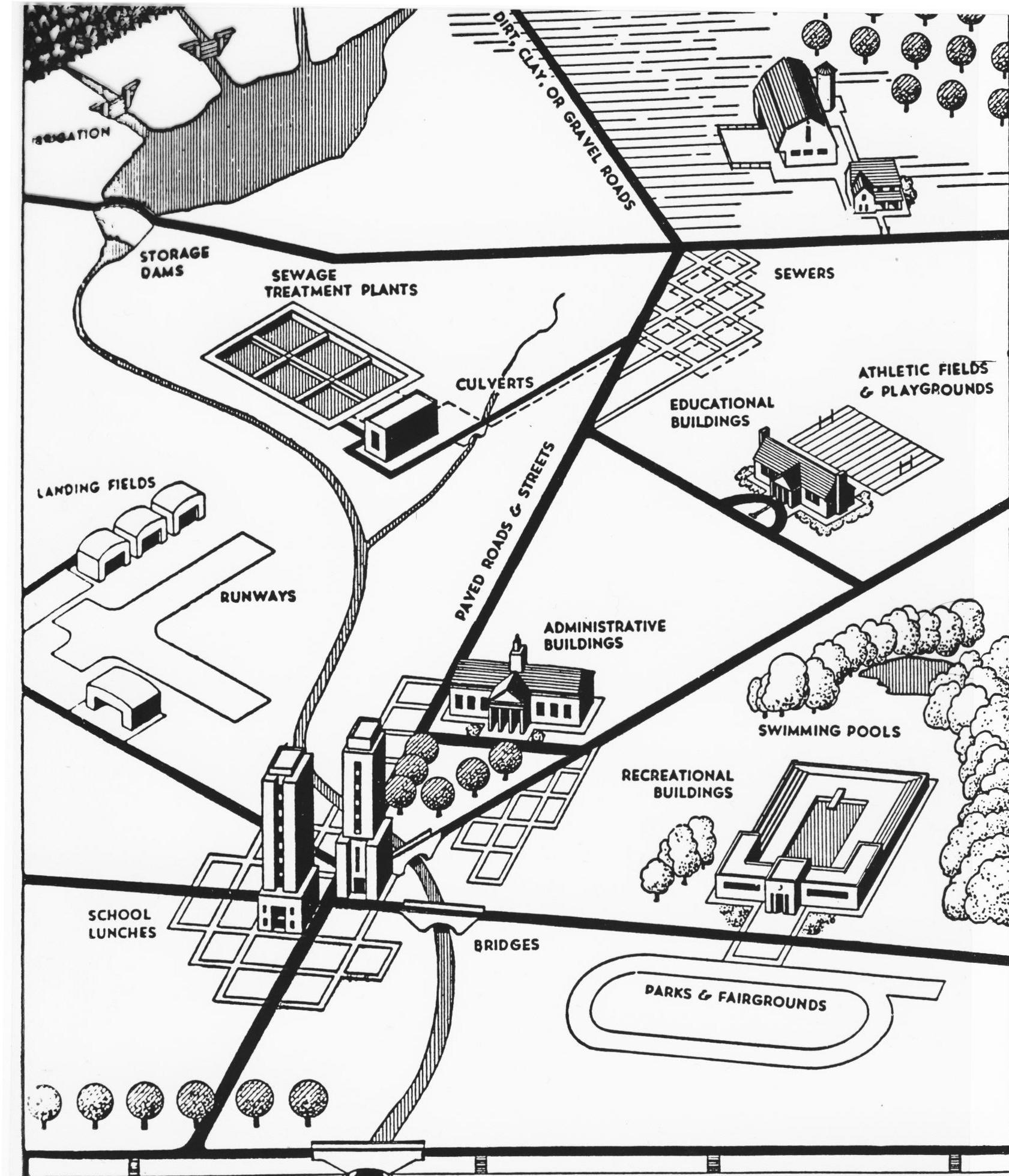
The book cronicles his work through the 1990's in the development of infrastructural urbanism. This can be understood in a way as a precursor or perhaps correlary to landscape urbanism, especially considering that Allen is/(was?) James Corner's partner in Field Operations.

His writing and drawings begin to form an understanding of infrastructure that is crucial to the formation of a successful project for this competition.

In his project for Barcelona, Logistical Activities Zone is particularly helpful in that it the project, though developed through traditional represenational strategies (plan, sections, models) is represented finally as a manual, in the form of a matrix of interconnected topics (surface, service, organization, structure, repetition, anticipation). Primary to this mode of represenation is the understanding of notation and scoring as a necessary means of representing the potentials of the infrastructural field.

Kahn's flow diagram for his traffic plan for Philadelphia, a particularly amazing project which is far understudied, is an early example of what notational represenation may accomplish. Further afield one may look toward the notion of scoring, as in music or dance, particularly the non-traditional scoring methods of Merce Cunningham and John Cage. Of course for urban landscape architecture this is old hat, see Lawrence Halprin's tome RSVP. Notations use in urban design allows for the production of "directed indeterminancy" wherein robust and specific proposals sustain overtime yet are open to supporting multiple interpretations.

hmmm... sorry I'm wandering here and I'm hungry for dinner. Since this is an informal thing I'm going to jot my notes on what I meant to write about: which is the specific meaning and intention of infrastructure as an architectural method. I'll flush it out later and fix this post rather than saving it an forgetting about it.

Infrastructure:
-establish realistic framework for future collective contribution
-constructing the site itself, preparing the ground for future building, conditions for future events.
via: surface, service, networks
Infrastructures medium is geography [it's method is choreography?]

"Traditional represenation presumes stable objects & fixed subjects."
The contemporary city is not an artifact.

Infrastructure - collective nature not the establishment of rules but the fixing of points of service, access & structure.

Infrastructure works strategically, but encourages tactical improvisation.

Infrastructure accomodates local contigencies while maintaining overall continuity.

catastrophe point - threshold at which continuitie's structure and function of a system is easily altered or broken.

Tuesday, June 16, 2009

Big Thinking Then and Now

I picked up a definitive study of the implementation and effectiveness of the original WPA

(Sorry for the giant image, I haven't really gotten the hang of the layout system here)


Our standard thinking ain't going to cut it for this competition.
See below some pretty lovely diagrammatic and graphical think making.

Friday, June 12, 2009

Directions

I invited everyone to post on the blog using their own google accounts, but if you want to do any administrative stuff you need to sign in to the account I created:

username: wparockstars@gmail.com
password: jamestice

This is an invite-only blog, so any information we post should remain between the 4 of us.  If you want to fool around with the format, layout, font, pictures, etc. of the blog, go right ahead. This is our account, not mine. Enjoy.  

Also, let's not take ourselves too seriously.


interconnections

To get the ball rolling on the variety of posts I expect from this group, I took these pictures at the conference I went to last week. The diagrams were of particular interest to me as they reminded me of our project 3 for Architectural Context. In this scenario the diagrams were used to describe the structure of PV chemistry. I think he was talking about the efficiency of thin-celled PVs but I don't really remember:


The last one is my favorite caption: 'interconnected nano-crystallites'

First Post

Hello gentlemen,

Welcome to our new google account. This account should be used to share ideas and communicate with each other while we are in our respective cities this summer. Regardless of the competition I would really like to keep up with what everybody is doing this summer. Studios, vacations, family engagements, whatever. I'm not very good at keeping up with people on the phone, so this could be a nice way to follow everyone's paths leading up to the fall when we will be in close coordinates again. I also set up a google group, but I thought the blog would be fun so that we could each add it to our own Google Readers and receive the RSS feed from it. I don't know about everyone else but I have gotten pretty used to my reader, and i think it would be fun to add our group blog to my list of daily news feeds. Let's see how this works for the first week or so, and if we don't like it then we can try something else. 

With that said, I have posted a few links for us to start the discussion: 1) The WPA 2.0 contest announcement and 2) The winners of the ACSA Green Communities competition to get an idea of what the student bar is set at right now with regards to competition entries. I have emailed the ACSA requesting full size PDFs of these winners and am waiting on a response. 

Lastly, I would like to say that if we do follow through on this, I am confidant we will make a pretty kick ass entry. I think we all bring something very different to the table, and I have been waiting to work on something with this group for a while now. Also if you guys aren't as excited about this, just humor me or tell me to put the brakes on. I didn't mean to suck everyone into a competition that they weren't all that excited about. I know we all need a break from the last year of school, so don't hesitate to tell me to relax.